skip to main |
skip to sidebar
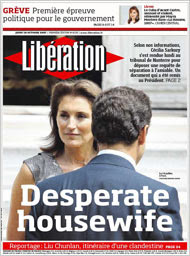 I watched the strikes unfold yesterday on the internet from my office. Interestingly, another news story edged the strike out of the top headlines during the day: the divorce of President Nicholas Sarkozy and his wife Cecilia.
For the most part, Paris went on as usual. The streets had more bikes than normal, including the new rental bikes provided by the city, the Velib. But the story of the divorce was seen as both ordinary and surprising. The French pride themselves on having a very different response to the private lives of their politicians compared to Americans. During the Clinton-Lewinsky scandal, the French probably shrugged and said "C'est normal." After all, former President Francois Mitterand was well-known to have a mistress by whom he had a child. The polls say that the majority of French people believe that this divorce will have no effect on Sarkozy's ability to work as President.
But, somewhat surprisingly, the Sarkozy divorce seemed to become the big news of the day. The President's private life had become public and was the subject of much discussion. Perhaps the French are more interested in these things than they like to admit. Or maybe Sarkozy, the "American-style" president is getting American-style media attention. There was a little bit of Schadenfreude (taking pleasure in the suffering of others, as the Germans call it) in the press which has been critical of Sarkozy.
But there are two ways to read this episode. On one hand, someone might pity Sarkozy because of his personal loss at a moment of political crisis. He had campaigned on the idea that his wife would be an informal member of his administration (a kind of Hillary Clinton circa 1992), but now she abandons him when he needs her most. Will Sarkozy's poll numbers go up as a result of sympathy?
But the other way to look at this is to note that on Wednesday, the presidential spokesman vehemently denied any impending divorce. Then, the very next day, it was announced as a fait accompli. Did Sarkozy time the announcement of the divorce to blunt the media's coverage of the strike? Here's a quote from one of Sarkozy's political rivals as reported in the New York Times: “The Élysée has chosen this Thursday, a day of strong social mobilization, to make the information official,” said Annick Lepetit, the Socialist Party’s national secretary, in a communiqué. “We will leave it to the French people to judge if it’s only a simple coincidence.”Either way, the strike continues today, and I'm back in the office rather than the library. And Paris rolls on.
(Image from the New York Times website)
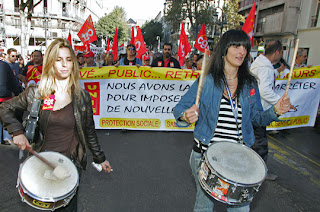 Paris -- and in fact all of France -- is not itself today because of an enormous transport strike (la greve). The Metro, commuter trains, buses, and the high-speed TGV that goes between cities are either not working at all or are on very limited schedules. Workers are protesting changes in the government's retirement policy, and have shut down one of the city's basic infrastructure elements to make their point. All this while thousands of English rugby fans are on their way to Paris for the Rugby World Cup final.
For me, it's kind of like a snow day. Everyone knew it was coming and made alternate plans. I cancelled my request at the library. Some things go on as normal, but other things are postponed. Our Institute tea is this afternoon, but if some people can't make it to Reid Hall, everyone will understand. We make do.
Much of the strike is bound up in the specifics of French politics. The new president Nicholas Sarkozy wants to revitalize the French economy -- along lines similar to the US, according to many -- but doing so creates not only an economic but a cultural conflict. Which is most important: working longer and making more money, or working less and having more free time? That's at the heart of the issues related not only to the strike but to why Sarkozy is so controversial. He won the presidency with a majority, but a substantial number of French voters hold onto long-cherished notions of being able to appreciate the "joie de vivre" that comes not with work but with leisure. That's why there is a 35 hour work week and a very early retirement age (in the 50s, I think).
Labor is still strong in France, and anyone who spends much time here has seen it in action. The first time I left France, the people who clean Charles de Gaulle airport were on strike; there were piles of garbage everywhere. Once when I went to do research in the National Archives, a sign was posted on the gate: "Archive on strike." I once saw a protest march by firemen. And now, the transportation strike of 2007. Strikes are a way of life here. Come to think of it, maybe Paris is acutally itself after all.
For more information, here are 2 New York Times articles to read: http://www.nytimes.com/2007/10/18/world/europe/18france.html?ref=world
http://www.nytimes.com/2007/10/18/opinion/18cohen.html?hp
(I got the picture from the National Public Radio website. I have not been out in the marches myself.)
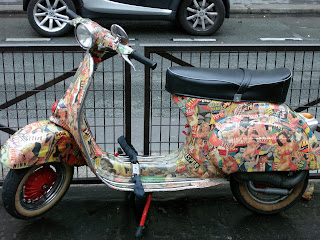 I saw this scooter on the street a while ago and had to take a picture. Its owner has pasted pictures and words cut out of magazines all over it to create a unique collage (click on the photo to enlarge). It looks like every surface is covered except for the seat and the handlebars. A snazzy way to get around the city.
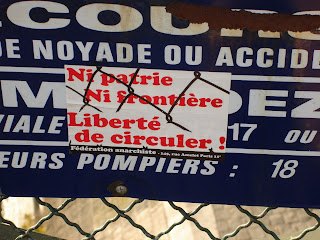 I saw this sticker on the Pont des Arts. It reads "Neither fatherland nor border. Freedom to travel." Posted by the Anarchist Federation, it challenges some of our most cherished notions in the West about the importance of the idea of a "homeland" with well-defined frontiers -- a nation-state that belongs to "us." In an increasingly global economy, people and goods are moving more and more freely across those borders. Yet we also hold onto the notion of differences between peoples.
It's interesting that Europeans are debating some of the same questions as Americans when it comes to who is allowed into the country (or the EU) and who is not. Drawing those boundaries have become important for some people in France for both economic and cultural reasons; many choose to blame immigrants for unemployment and for cultural decline. These are the same kinds of issues raised by those who want to build a wall along the Mexican border.
I'm not sure what the answers to these complicated questions are, but it seems clear that the conflicts will continue to grow. We want the benefits of a global economy without the costs that come with the increased mobility of money, jobs, goods, and people. It may be hard to have both.
Well, I can't say much today or show any pictures because the wireless internet in the apartment is not working. At least we do have a computer lab in the basement where I can type this message. Just another part of the ongoing struggle with French technology.
Perhaps this does give me an opportunity to reflect on one thing since it's literally on my fingertips right now: French keyboards are different from those in the US. It's a small set of differences, but just enough to slow down my typing. It turns me from a pretty fast typer into something of a hunt-and-peck typer, just by moving a few keys around.
For instance, the center row of keys on a French keyboard is qsdfjklm -- rather than asdfjkl; -- so when I need the letter a, I often get the letter q because it's in the place where the a is on a US keyboard. Punctuation is in different places too, and you have to use the shift key to make a period. In the internet age, the @ sign is very important, but on a French keyboard, you have to use Ctrl-Alt-0 (excpet that it's not really the 0 key since all numbers must be made using a shift).
And of course they have keys we don't have, in particular letters with accents: é and è and à are all in the top row of symbol keys, except that you don't have to use shift to make them.
Funny how a few keys in a different place makes for a different linguistic experience in something as basic as typing.
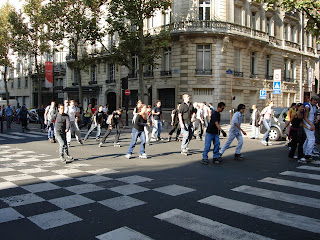
 I've never seen so many people out and about in Paris as I did today, especially in the Jardin du Luxembourg. But then it has been a perfect fall day, mid-60s, a little warmer in the bright sunshine. Elsewhere, I encountered one of the groups of roller skaters who tour around the city from time to time. In these groups, there are hundreds, maybe a thousand people who roll together as an enormous pack through the streets. These photos don't really capture the size of the group.
 Not far from the apartment is Le Tennessee Jazz Bar. I've not been in, and there aren't any signs out front saying who plays there or what kind of place it is. But it struck me as odd since I'm not sure we would use the phrase "Tennessee jazz" in the US. We might talk about Memphis blues, or Tennessee country music. There is jazz in Tennessee, of course, but I'm not sure that "Tennessee jazz" is a unique genre. They probably just thought that Tennessee would be a clever American name to use. The image of the saxophonist on the sign is clearly of an African-American (in a zoot suit, it seems), so maybe they wanted to choose a southern state? But why not New Orleans or Louisiana jazz? Maybe the owner had visited Tennessee at some point in the past.
This one may remain a mystery, but it's always interesting to wonder about which parts of American culture the French choose to pick up on. What exactly do Parisians think of when they hear the name Tennessee? Apparently, some think of jazz.


